


A Patch of Rabbit’s Foot Fern on a Mossy Slope: Sharing a New Moss Terrarium

Updated: Apr 27
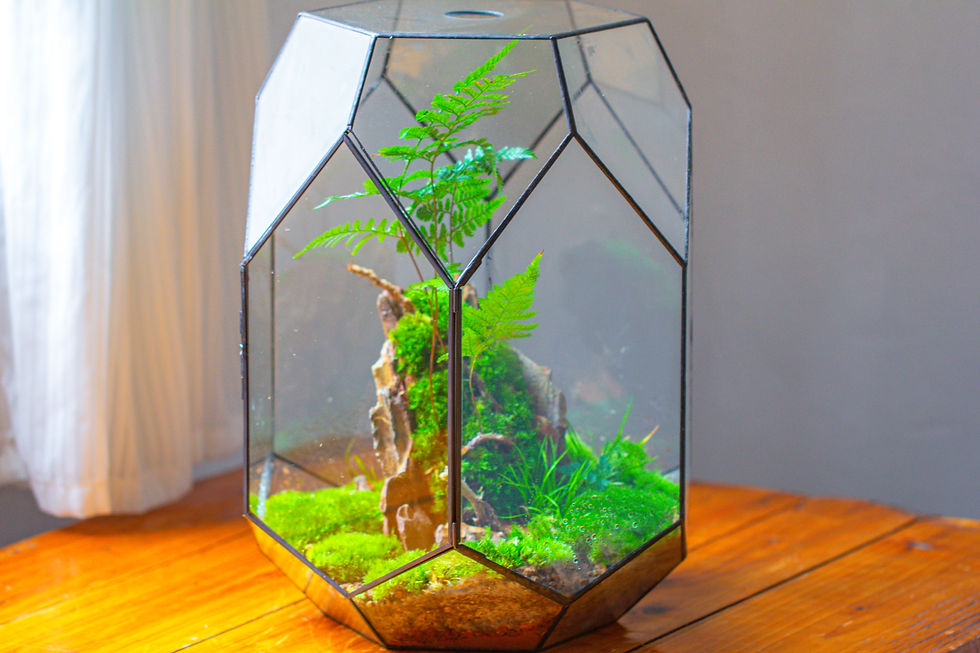
The plant selection for this setup is very simple: just rabbit’s foot fern, Leucobryum moss (pincushion moss), and a few small Acorus calamus plants.
The build itself is also straightforward. The base layer is made of pumice, sphagnum moss, and akadama soil. Two large, flat pieces of dragon stone are used to form the slope. I glued these two stones together in advance and deliberately created a slight depression. A few smaller stones were placed along the sides as decoration.
Leucobryum moss (pincushion moss) is laid directly at the bottom, and a small Acorus calamus is casually planted next to the smaller stones.
A thick layer of red clay is applied over the stone slope. The cutted roots of rabbit’s foot fern is then inserted directly into the clay.
Red clay is naturally sticky, so it holds the rabbit’s foot fern very securely. Once the fern is fixed in place, Leucobryum moss can be tucked into the gaps between the fronds. The red clay anchors everything firmly.
My intention was to use rabbit’s foot fern to mimic a tall forest growing on a hillside.
The true focal point of this terrarium is the rabbit’s foot fern, and the interior space was deliberately left to accommodate the growth of its roots.
Its planting video:
for how to glue the rocks, I have a series of tutorial uploaded on my youtube channel. If interested, please check my channel.
second moss terrarium with the same terrarium:
Simple Build – Easy Moss & Ficus Terrarium
about this terrarium:
The advantages are obvious:no special tools, no expensive plants, no fancy hardscape materials, and very easy maintenance.
Materials
One bag of 3–9 mm lava rock (small gravel)
Some sphagnum moss or dried moss
Several pieces of larger lava rock (no need for uniform size—mixed sizes work best)
Plants:
Cushion moss (Leucobryum)
Ginseng ficus (Ficus microcarpa)
Step-by-Step Setup
1) Base Layer
Add a layer of 3–9 mm lava rock at the bottom.Then add a layer of pre-moistened sphagnum or dried moss.
2) Place the Rocks
Add the larger lava rocks.Arrange them however you like, but make sure to leave a larger gap in the center for planting the ficus.
It’s ideal if the rocks interlock naturally, but it’s not required.
3) Plant the Ficus
Place the ficus in the central gap.
You can remove some excess soil from the roots to expose more root structure
At the base, you can use its original potting soil or fill with sphagnum moss
4) Fill Gaps with Moss
Insert sphagnum moss into the gaps between rocks—anywhere you plan to grow moss.
5) Fill with Small Lava Rock
Add more 3–9 mm lava rock to fill the remaining gaps between the large stones.This helps stabilize the structure so the rocks don’t shift.
How much sphagnum vs. lava rock?Simple rule:As long as the large rocks don’t move, you’re good.Sphagnum helps reduce cost and weight, so you don’t need to use too much gravel.
6) Add Cushion Moss
Place the cushion moss on top.
7) Optional Plant
You can also tuck in a small Saxifraga among the moss for extra detail.
Extra Tip
If your ficus starts growing new shoots:
Cut them off
Stick them directly into another spot in the terrarium
After they root and grow, you can either keep them or give them away
Care
Mist with water
Usually once or twice a week is enough
If the bottom stones become wet, that means you are overwatering.Proper watering should keep the surface moist while the interior remains relatively dry.
update on 2026, late April


What a wonderful, serene world you have portrayed here with the rabbit's foot fern tumbling down the moss-covered hill. It makes one realize how nature has its own unique way of making its custom Canada patches green that beats all man-made efforts, really!