


Creeping figs: Ficus pumila 'Quercifolia' or Miniature Oakleaf Fig
- Lea

- Jun 14, 2024
- 3 min read
Updated: Feb 11
This is one of my favorite terrarium plants. You see it in my various terrariums: moss wall, corner terrariums, spider terrariums.
This blog will talk about this plant and share my experience about raising them.
Formal name of creeping figs: Ficus pumila ‘Quercifolia’ or Miniature Oakleaf Fig
Ficus pumila ‘Quercifolia’, commonly known as the Miniature Oakleaf Fig, is a charming dwarf cultivar of the creeping fig. Its defining feature is the tiny, deeply lobed leaves that closely resemble miniature oak leaves—dense, textured, and irresistibly delicate. This plant is a favorite in terrariums, moss gardens, and small-scale landscapes where fine detail matters.
Key Characteristics
Leaf form: Small, oak-shaped leaves with pronounced lobes
Growth habit: Creeping and climbing; forms tight mats over time
Texture & scale: Extremely fine, ideal for miniature scenes
Color: Fresh to deep green under stable light and humidity
Creeping figs grows fast in a close moss terrarium.
Light
Bright, indirect light
Tolerates medium light but slows down noticeably
Avoid strong direct sun, especially in closed containers
Water & Humidity
Prefers consistently moist
Thrives in high humidity
Excellent choice for closed or semi-closed terrariums
Substrate
Its natural soil is red clay soil. It can grow on almost every things, live moss, sphagnum, akadama, lava. It is not picky at all.
Temperature
Ideal range: 18–28 °C (65–82 °F). It can endure higher temperature and lower. Even in some nights, temperatures below 10 °C (50 °F) will be ok.
How to propagate
Each pair of leaves on Ficus pumila ‘Quercifolia’ has tiny roots forming on the underside. Simply cut a short section of stem and place it directly onto moist moss—it will root on its own.
How to grow it beautifully
In the wild, this plant creeps along soil slopes and climbs up tree bark, clinging tightly to the surface like a living tattoo.
Don’t let the small leaf size fool you into thinking it should be grown in a tiny cup or container.
I’ve seen people grow it in clear coffee cups. The problem is that a coffee cup is far too short—it gives the plant no vertical space to climb. If you want Ficus pumila ‘Quercifolia’ to grow into something that’s visually appealing and instantly likable, the container doesn’t need to be wider, it needs to be much taller—at least three times the height (of a typical transparent coffee cup, 420ml, 59mm wide x 100mm height) .
This plant needs something to climb. Only when it’s allowed to climb does it really look good.
What I let it climb on
I usually provide three types of surfaces:
Glass
Check out my other articles, especially the spider terrariums and moss wall terrariums. Ficus pumila ‘Quercifolia’ looks stunning when it climbs directly on glass walls.
Stone
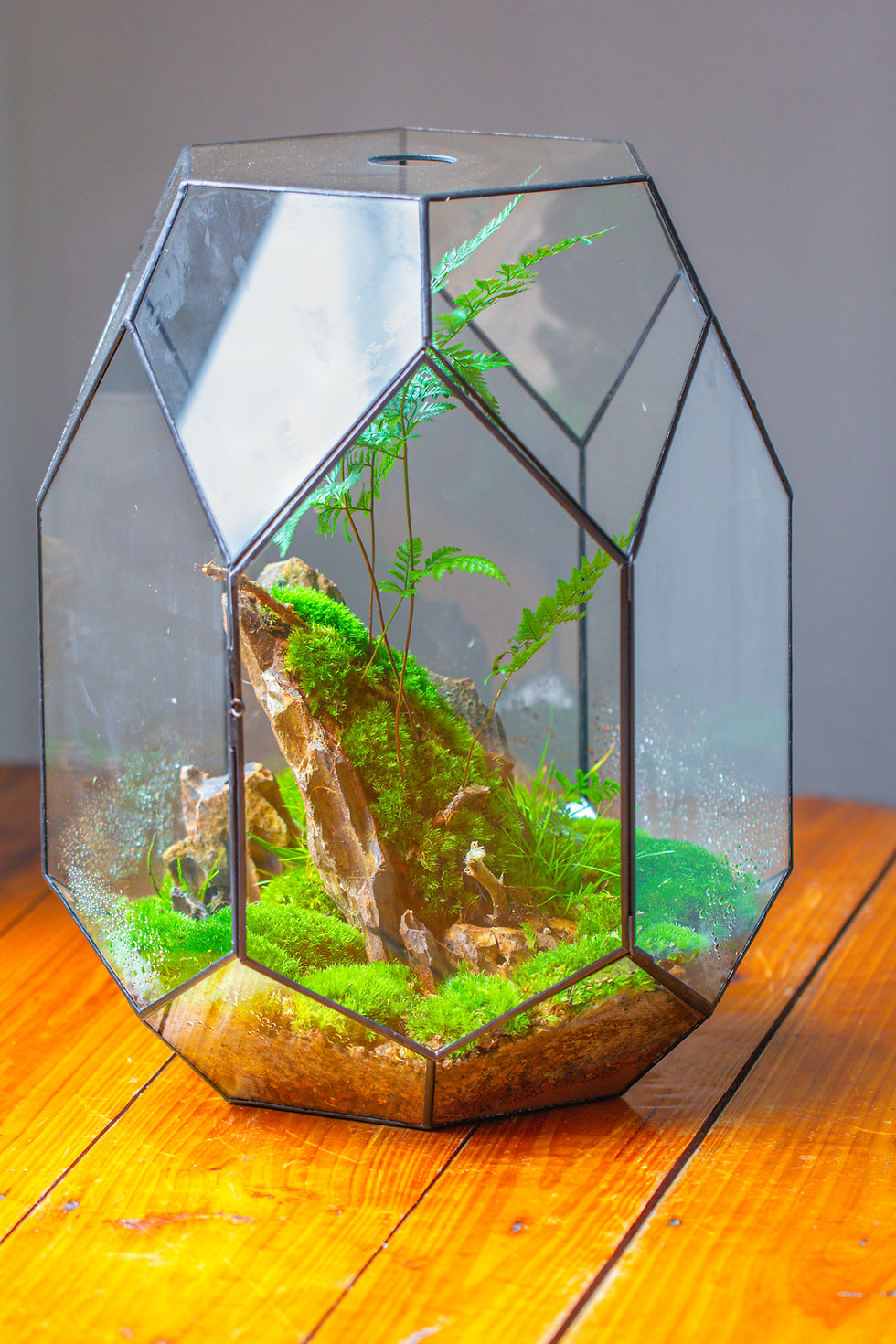
I’ve also made terrarium projects combining this plant with stone. However, small stones limit its visual impact. Larger, taller stones look much better—but they’re heavy, expensive, and require more space and effort to keep humid at home. That’s why wood often becomes a better alternative.
Wood
See my previous spider terrariums and mantis terrariums. When Ficus pumila ‘Quercifolia’ climbs thin branches, it looks like an old tree sprouting fresh new growth. Check the phtos below, I used two fairly thick pieces of wood inside a tall container. The plant simply climbed up on its own.
Maintenance
I mist it frequently.
Pruning is necessary. It grows very fast in moss terrariums.
In fact, slightly sparser growth looks better. Every so often, I just cut off a whole section.
Moss pairing
If you want to pair Ficus pumila ‘Quercifolia’ with moss, choose Hypnum moss.
Do not use pincushion moss (Leucobryum).
Hypnum moss can coexist with Ficus pumila ‘Quercifolia’ without being overwhelmed. Pincushion moss cannot—it’s at a complete disadvantage and will eventually lose out.



Comments