


How to Feed and Care for Mantises and Jumping Spiders in a Live Plant Terrarium

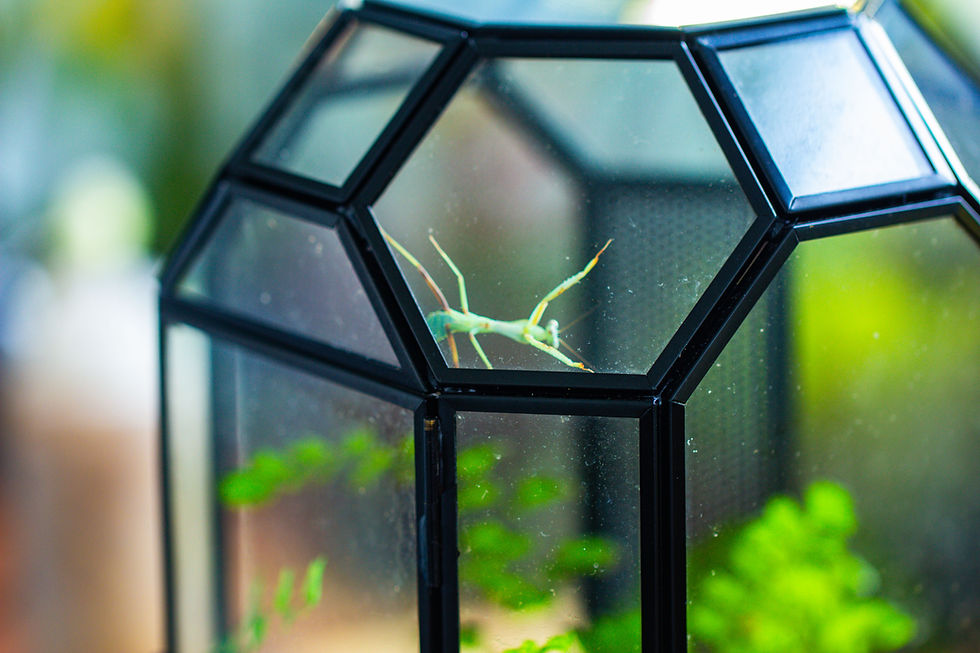

I built some bioactive terrariums for keeping mantises, so I think I need to write this artical talking about how to feeding them.
How to Keep a Praying Mantis
1. What do praying mantises eat?
Fruit flies.
Please note:
Here I am not trying to cover the full diet of mantises. I am only talking about the easiest and most convenient food source that most people can get: fruit flies.
Fruit flies are especially useful for baby mantises, small mantis nymphs, and small jumping spiders. They are easy to find, easy to culture, and easy to feed.
For larger mantises, you can also use other suitable live feeder insects depending on the size of the mantis.
2. What do praying mantises drink?
Praying mantises mainly drink by licking water droplets after misting. So a light misting is enough. They will drink from droplets on leaves and moss by themselves.
I have always used real plants, and I mist the plants every one or two days, so I have never needed to add a water feeder.
Some mantis keepers use artificial plants, and they also mist water onto the leaves of those artificial plants.
Some keepers use a very shallow dish with pebbles or sponge for humidity, but it is not necessary in my setup.
3. How do you clean mantis droppings?
You do not need to.
In a mantis enclosure, the droppings are very hard to find, let alone noticeable enough to affect the appearance. I have posted some videos of my mantis terrariums. Some have already been published, and some are still waiting to be posted. You can see for yourselves: apart from the plants, you can hardly see any so-called mantis droppings with your eyes. The enclosure looks very clean.
Other than wiping dust off the glass walls for photos, I have never really cleaned them.
What I do often is maintain the plants. Just open the door directly. Mantises are quite shy and will usually move away. If the terrarium has a separate base and glass cover, you can simply lift the cover while the mantis is on it, place it on a nearby table, and then take care the plants in the base. For house-style terrariums, you can just reach inside.
It is very convenient.
Please note:
When I say mantis (including below jumping spider) droppings do not need to be cleaned, I am talking specifically about the well-ventilated terrariums I use.
In these terrariums, the droppings are tiny, dry quickly, and are almost impossible to see with the naked eye. They do not affect the appearance of the setup. What actually needs attention is not the droppings, but uneaten prey, dead insects, moldy food, or leftover feeder insect pieces.
So for my live planted, well-ventilated terrariums, routine cleaning for mantis or jumping spider droppings is basically unnecessary.
A Note About Jumping Spiders
Jumping spiders eat and drink in a very similar way to mantises.
1. What do jumping spiders eat?
Spiderlings eat fruit flies. Fruit flies are the best choice.
Adult jumping spiders can also be fed fruit flies.
Spiderlings do best with fruit flies. Adult jumping spiders can eat larger flies, bottle flies, small roaches, small crickets, small mealworms, or waxworms. Fruit flies can still be used, but they may be too small for large adults.
2. How do jumping spiders drink water?
Jumping spiders drink water in a similar way to mantises. They drink from water droplets on plants. So misting is enough.
Some jumping spider sellers often include a small water feeder. In fact, this can be dangerous for jumping spiders, especially spiderlings, because they may drown.
In the wild, small animals like spiders and mantises mainly drink from moisture on plants. They are not like cows or sheep looking for a pond to drink from. That simply does not make sense.
3. How do you clean jumping spider droppings?
You do not need to. You can hardly see them with the naked eye. What you should remove is uneaten prey, dead insects, moldy food, or feeder leftovers.
So Here Comes the Question: How Do You Get Fruit Flies?
Some people may think fruit flies are dirty.
But fruit flies, as the name suggests, feed on fruit.
Fruit flies raised on clean fruit or a clean culture medium are much cleaner than many people imagine. However, I do not recommend collecting flies from trash bins, sprayed areas, or unknown outdoor sources if they will be used as feeder insects.
If you plan to buy them online, simply search for flightless fruit flies. Usually, buying them once is enough. You can then make several fruit fly culture bottles using the below method , add a few adult fruit flies into a new bottle , and let them reproduce on their own.
It really does not cost much. Leftover fruit, unused bottles, coffee cups, and bubble tea cups are all things most people already have plenty of.
Here share a way to capture flytraps, and it is also the same way you can multiply them at home.
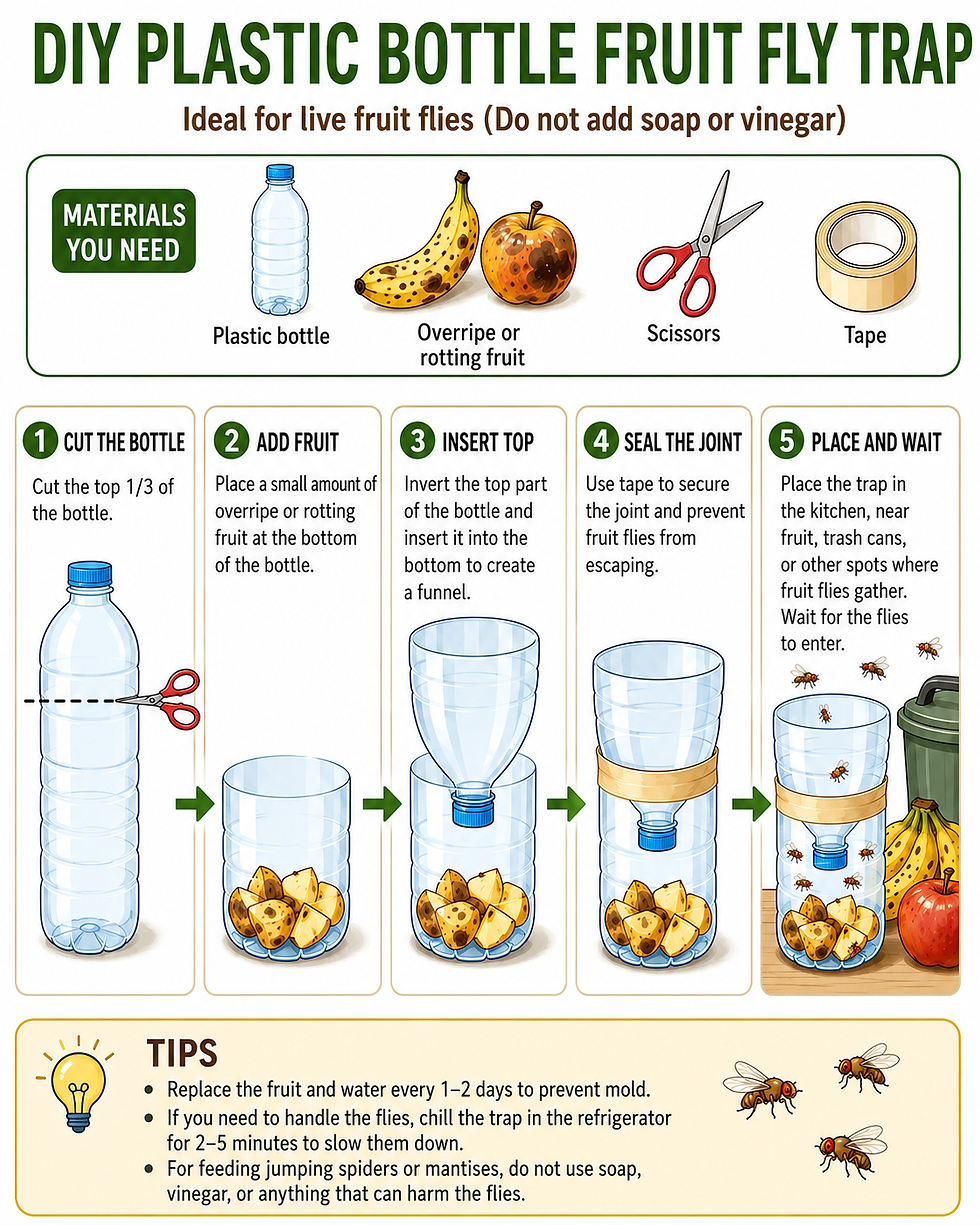
I personally use a ketchup-style squeeze bottle because my carnivorous plants, jumping spiders, and mantises all eat fruit flies. It is very clean and convenient.
Things to Note
You can directly use a clean bubble tea cup or coffee cup. Cover the top with plastic wrap and poke a few small holes in the plastic wrap.
If the fruit flies are too active, chill them briefly. Once they slow down, you can handle them easily, whether you want to pick them out with tweezers for feeding or transfer them to another container.
You can also use sugar water. Just do not add dish soap or anything similar.
Which Insect Actually Needs Cleaning?
Snails, especially large African snails.
Snails produce mucus, so you need to clean the glass.
Snails also eat plant leaves, but they usually will not kill the plants. The small snails you find in grass or flowerpots cause almost no damage to moss.
Also, do not keep giant African land snails in a pretty moss terrarium. They are large, need a lot of space, and eat a lot. A moss terrarium that could house a frog or a small lizard can be completely turned over by two giant African land snails overnight. Ferns, fittonia, and other plants may be eaten right after you plant them, including the roots.
Do not keep them in your beautiful moss landscape. In a planted moss terrarium, giant African land snails behave more like tiny bulldozers than display animals.
Here are more insects terrariums I am using, they all have large facing vented panels.


Comments