


How Different Mosses Grow on Lava Rock


I took these photos at a botanical garden.
There was an area full of moss and other shade-loving plants, including rabbit's foot ferns, maidenhair ferns, and prayer plants.
Here in Guangdong, southern China, moss often grows beautifully in damp, shaded areas beneath the trees, especially in places with hills and streams.
One thing caught my eye immediately: the rocks beside the water were lava rock.
I saw many different kinds of moss growing on the lava rock, so I took some photos.
If you want to create a large or small moss landscape at home, especially one near water, or if you simply enjoy growing moss, these photos may give you some ideas.
The moss in the next photo is what we often call small sheet moss, including the short, velvety types. When it spreads into a continuous layer, it looks really beautiful.
The surrounding rocks also have moss on them, but none of it is growing as well as this patch. I think there are two possible reasons. First, this spot is closest to the water. Second, it is a small, flat ledge where rainwater has probably deposited some soil. I think that accumulated soil is the main reason the moss is doing so well here.

The next photo shows another piece of lava rock near the water, but without the same buildup of soil and mud.
If you look closely, you can see some moss that resembles the moss in the previous photo. But there are many other kinds mixed in as well. This is a much more varied patch.

Can you spot any Philonotis moss here?


These next ones should look familiar: Bryum moss and Racomitrium moss. They are old friends by now. I seem to spot them everywhere.


Here is another rock. Notice that it also has a relatively flat surface where some muddy water and soil have collected. That thin layer is enough for the small patches of moss to join together and form a green carpet.

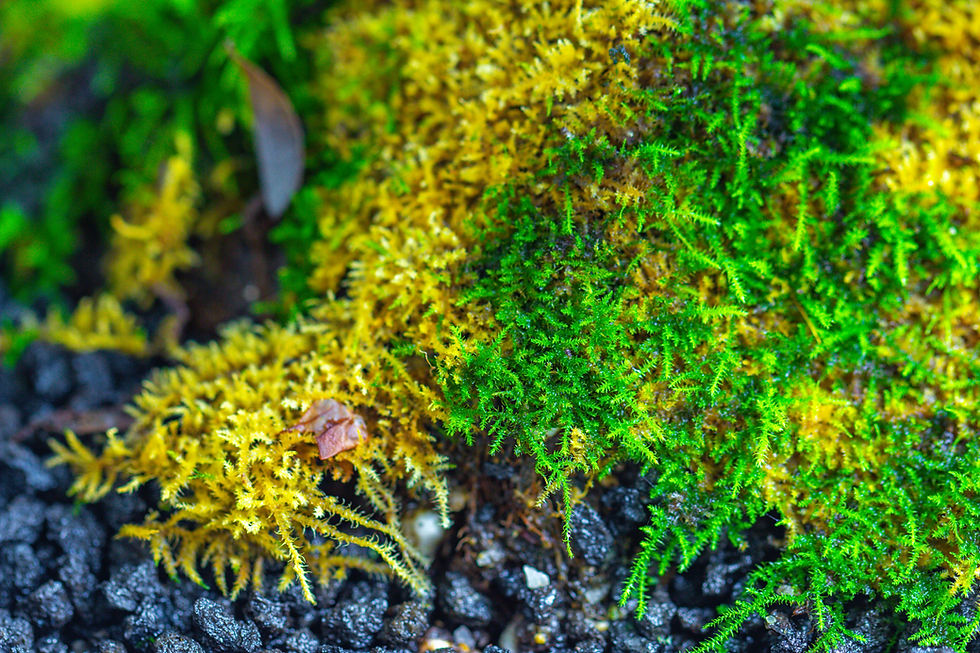
Here is a closer look. Does this moss seem familiar? Doesn't it look just like the moss that covered the terracotta flowerpot I shared before?

Lava rock has lots of pores, which makes it especially suitable for moss to attach to and grow on. Look at the next photo and see how the moss is gradually spreading and claiming new territory.

Another beautiful green carpet made of moss.

Even peacock spikemoss (Selaginella uncinata) joins in.

The next photos show a stone wall made of lava rock, almost completely covered in moss.
Now think back to the first photo. You might wonder why the two rocks near the top of that photo were not completely covered in moss, while this wall is.
First, I think more soil has washed down from above and collected on this wall. The moss here also has ferns and other plants growing above it, providing some shade.
As for those two rocks in the first photo, I believe that with enough time, rain, and weathering, they could eventually look like this wall too.


Finally, here are a few photos I took of lava-rock paving.
If you live in southern China and want to make your own moss garden, I think lava rock is one of the best materials to use.
First, its rough, porous surface gives moss plenty of places to attach and spread. Moss can move across it surprisingly quickly.
Second, it is a clean and simple material to work with. You do not even need to add soil yourself. Over time, wind and rain will naturally bring in enough fine soil for moss to establish itself.
The older the landscape gets, the more beautiful it can become.
Just look at these photos. Even the botanical garden uses lava rock as a main material for its moss-covered paths and surfaces.



Comments