


Moss Doesn’t Need Soil: A Practical Guide to Substrates, Watering, and Fertilizing Terrariums


When It Comes to Moss, Soil Really Isn’t That Important
This article is mainly about terrariums under 30 cm in size. When I mention growing moss outdoors, I mean moss planted directly in a garden or flowerpot—not a terrarium placed outdoors.
When people build a moss terrarium, one of the first questions they often ask is: What kind of soil should I use?
But moss does not have true roots. Unlike most vascular plants, it does not depend on soil to anchor itself or absorb nutrients through a root system. As long as it has suitable light, temperature, and moisture, moss can grow on rocks, wood, and even plastic.
Some epiphytic plants and small tropical plants suitable for terrariums do not necessarily need traditional potting soil either. However, they usually still need a growing medium that can support their roots, retain moisture, and provide a small amount of nutrients.
So, what we commonly call “soil” in a moss terrarium is more accurately described as a growing medium.
The main purpose of these growing media is not to provide large amounts of nutrients like ordinary potting soil. Their real purpose is to manage the relationship between plants and water: when drainage is needed, when water retention is needed, how to attach moss to a vertical surface, and how to maintain the right moisture balance inside the terrarium.
1. Why Does a Moss Terrarium Need a Drainage Layer?
Water management is very important in a moss terrarium, especially in small terrariums and glass bottles.
Moss needs plenty of moisture, but most terrestrial mosses are not suited to being completely submerged in standing water for long periods. A moss terrarium should keep the moss moist while preventing water from covering it continuously.
If you want to grow moss fully submerged, you should choose an aquatic moss that is adapted to underwater conditions rather than an ordinary terrestrial moss.
For terrestrial moss, we therefore need to keep it away from standing water at the bottom. This is why a drainage layer is necessary.
For this layer, you can use any porous, well-aerated material that allows excess water to drain away. As long as the material has these qualities, the exact type is not particularly important.
I often use small pieces of lava rock. Akadama, diatomite, small pumice stones, and aquarium clay pebbles also work well for drainage. Even cinder, which I have mentioned before, can be a porous and well-aerated material.
However, be careful when choosing clay pebbles. You need the heavier kind that sinks and stays at the bottom, not the lightweight kind that floats as soon as it comes into contact with water.
2. When Is Water Retention Necessary?
In addition to drainage, there are also many situations in which a terrarium needs a water-retaining layer.
Because of gravity, water always moves downward. If moss is planted high in the terrarium, moisture in that area is easily lost. You may find that the moss at the top is already dry while the bottom is almost waterlogged.
In this situation, you need a material that can retain water.
Sphagnum moss is the most commonly used option. You can lay living moss over sphagnum moss or wrap sphagnum moss around the roots of a plant to help retain moisture.
When I use the term “sphagnum moss” here, I am not referring only to the sphagnum commonly used for growing orchids. I also use other types of dried moss. For example, if you look closely at some of the dried green moss sold for orchids, you may find that much of it is actually dried hypnum moss. I often mix these materials together.
In addition to sphagnum moss, I frequently use red clay. Red clay also has excellent water-retaining properties.
3. What Growing Medium Should You Use for a Moss Wall?
In addition to drainage and water retention, there is another common situation in a moss terrarium: attaching moss to a vertical surface. This is where people often use what is sometimes called a “vertical planting substrate.”
For the terrariums under 30 cm that I make, I still use red clay.
Red clay is naturally sticky, so it can adhere directly to glass. It also retains water very well. Placing moss over red clay helps hold it in position while keeping moss growing in higher areas moist.
That is why I often use red clay to make small moss walls.
For me, whether I am growing moss or small tropical plants in a terrarium, the growing medium generally has three main purposes: drainage, water retention, and securing the plants in place.
Once you understand what problem needs to be solved in a particular area, you will know which growing medium to use.

4. How Should You Choose Artificial Planting Fabric?
Lava rock, sphagnum moss, and red clay are all natural materials. There are also many artificial planting materials available.
I rarely use these products because most of the terrariums I make are small, and I personally prefer natural materials.
However, when I first started learning about moss terrariums, many different types of artificial planting fabric were already being sold online, and many people were buying them. I also bought some to examine, but I eventually decided that they did not fit the natural style I wanted to create.
These artificial planting materials can generally be divided into two categories: planting fabric and background panels.
If you read the descriptions of planting fabrics online, you will often see claims such as “excellent water absorption and retention,” “high water-holding capacity,” “effective water transfer,” and “helps moss and other plants grow more vigorously.”
This tells us what these products are really designed to do.
In terms of function, planting fabric can be understood as a kind of “artificial sphagnum moss.” Both can transport and retain water while helping to hold plants in place.
A common way to use planting fabric is to wrap it around a branch before attaching moss over it. Some more advanced planting fabrics contain wire inside, allowing you to bend them into different shapes and then attach moss directly to them.
However, different planting fabrics vary greatly in their water absorption, breathability, and durability. When buying one, do not rely only on advertising claims such as “high water retention.” You also need to consider whether the material is suitable for your particular terrarium structure.
Whether you need planting fabric mainly depends on where the moss will be placed. If it will grow high in the terrarium or be attached to a branch that dries out easily, planting fabric can help transport and retain water in that area.
5. What Is an Artificial Background Panel For?
The other type of artificial material is the background panel.
You rarely see me using artificial background panels because I prefer to build backgrounds with real rocks and wood. Natural materials look more attractive and realistic.
Most of the terrariums I make are under 30 cm, so a background does not require very many rocks. The smaller rocks suitable for these terrariums are also usually among the least expensive, so there is little need for me to use artificial background panels.
Some artificial background panels are made from plastic or foam and are used only for decoration. They do not absorb or retain water. To be honest, these plastic backgrounds can also look quite artificial.
Some planting fabrics, however, are designed to function as background panels. The manufacturer may suggest growing moss and other plants directly on the planting background fabric.
This type of material can work because it forms a water-absorbing and water-retaining layer.
It is therefore important to understand the difference. An ordinary plastic or foam background panel is mainly decorative. Planting background fabric can shape the background while also absorbing and retaining water. They do not serve the same purpose.
6. Can You Attach Moss Directly with Moss Glue?
Traditionally, there have been two common ways to attach moss in moss terrariums and ecological terrariums. One is to tie it in place with fishing line, and the other is to attach it directly with moss glue. These glues are still widely available online.
Glue can certainly hold moss in place, but I personally do not recommend relying on glue alone unless you have already created a water-absorbing and water-retaining layer for the moss.
The problem is not that there is no soil underneath the moss. The problem is the glue does not retain water.
Moss does not depend on soil to anchor itself. What truly matters is light, temperature, and moisture.
High humidity can slow down water loss, but it does not necessarily mean that the moss has received enough water. Moss still needs mist, dew, or another form of liquid water to rehydrate.
Inside a terrarium, gravity continually pulls water downward. This can easily create a situation in which the top is dry while the bottom is waterlogged. If moss is glued directly to a branch, the moss growing higher up can dry out very easily.
This is why people often wrap a layer of water-absorbing planting fabric around a branch before tying or gluing moss over it.
I use red clay instead of moss glue. Red clay holds the moss in place while also absorbing and retaining water.
Some people ask whether moss can be glued directly to a background panel.
Glue can hold the moss in place, but it only solves the attachment problem. It does not solve the problem of water moving downward. If the background itself cannot absorb and retain water, moss growing higher up will still dry out easily.
Planting background fabric can support moss and other plants because the material itself forms a water-absorbing and water-retaining layer.
7. How Should You Water Moss?
Before discussing watering, we first need to understand one thing: moss does not have true roots. It mainly absorbs water and dissolved minerals through the surface of the plant.
This is why moss does not depend on soil for anchoring itself or absorbing nutrients through a root system. However, the growing medium can still affect how long moisture is retained, as well as the pH, mineral content, and microenvironment around the moss.
As long as it has suitable light, temperature, and moisture, moss can grow on poor soil, rocks, wood, and even discarded plastic.
Many mosses have a strong ability to tolerate drying. When they become dry, they temporarily stop growing. After receiving water again, some species can resume their metabolism, turn green, and start growing again.
You may have seen this happen yourself. Packaged dried sphagnum moss sold for growing orchids or carnivorous plants sometimes produces new green growth after it has been rehydrated.
This shows that some moss tissue, or propagules remaining in the dried sphagnum moss, can begin growing again after a period of dryness.
However, drought tolerance varies greatly among moss species. The rate of drying, the length of the dry period, and the environmental temperature can all affect whether the moss is able to recover. We therefore cannot assume that every type of moss is impossible to kill by drying it out.
Mosses such as Racomitrium japonicum, which naturally grow in environments that periodically become dry, generally have strong desiccation tolerance. Mosses that live in streams, wetlands, or consistently damp and shaded environments may not tolerate drying as well.
Moss likes moisture, but that does not mean that every moss can remain submerged in water for long periods.
Mosses belong to an early group of plants that adapted to life on land, but they still depend heavily on water from their surroundings. They prefer moist environments, but most terrestrial species should not remain in warm, oxygen-poor standing water for extended periods.
This moisture balance is one of the most important things to understand when growing moss.
8. How Often Should You Mist an Indoor Moss Terrarium?
This section mainly discusses indoor care.
Growing moss outdoors is a different situation. I have also grown healthy moss outdoors ( in a hot tropical coastal city), planted directly in a garden or flowerpot, where it remains green throughout the year.
Indoor conditions are different from outdoor conditions, especially when air conditioning or heating is used.
Both air conditioning and heating dry the air. Even moss with relatively strong drought tolerance will struggle to maintain healthy growth if it remains in such a dry environment for a long time.
Most modern indoor spaces use heating in winter and air conditioning in summer. This is why I always recommend growing moss inside a terrarium.
The smaller the moss work is, the more quickly it loses moisture. Without a terrarium, it will dry out easily (super hard to maintenance).
If your moss work is too large to place inside a terrarium or cover with a glass dome, keep it away from heating and air-conditioning vents.
It should not be placed in an area with excessively strong airflow either. The stronger the airflow, the faster the water evaporates.
During summer in an air-conditioned room, a relatively enclosed terrarium with a door may only need additional water every few days.
(Do not water according to a fixed schedule alone. Look at whether the surface of the moss is becoming dry, how much condensation is present on the glass, and how much water has collected at the bottom before deciding whether more water is needed).
Under my conditions, misting this type of small, enclosed terrarium once every two or three days is usually enough. The exact frequency will still depend on how well the terrarium is sealed, the heat produced by the light, the growing medium, and the type of moss.
9. When Should Outdoor Moss Be Watered?
Here, outdoor moss means moss planted directly in a garden, on the ground, or in a flowerpot.
If you grow moss outdoors, it is best to water it during the cooler early morning or evening.
At midday in summer, the ground, flowerpot, and moss itself may already be very hot. If you water at this time, the water held by the moss can also heat up quickly. Moss likes water, but it can be damaged by these hot and wet conditions.
For this reason, outdoor moss should not be watered at midday, especially during hot summers in southern regions.
Outdoor moss should also be kept away from excessively windy locations. Strong airflow can make it dry out very quickly.
10. Does a Moss Terrarium Need Fertilizer?
Moss needs nitrogen, phosphorus, potassium, and trace minerals, but usually only in very small amounts.
It can obtain small amounts of nutrients from rainwater, dust, the growing medium, and decomposing organic matter. For this reason, moss in a small, enclosed terrarium generally does not need additional fertilizer.
Fertilizer that is too concentrated may damage the moss and encourage algae to grow.
But what if there are other plants in the moss terrarium?
First, remember that plants suitable for ecological terrariums generally do not require much fertilizer. Their nutritional needs are usually quite low.
If these plants show signs of nutrient deficiency, such as slower growth or fading leaf color, you can greatly dilute a liquid plant fertilizer and apply a small amount to the leaves or around the roots. Try not to spray large amounts directly onto the moss.
Do not use too much fertilizer at once.
Think about the natural habitats of these small plants. Maidenhair ferns, for example, often grow in cracks between rocks or bricks. There is very little fertilizer in those places.
Plants in a moss terrarium therefore do not need heavy feeding or excessive watering. Light, humidity, and a proper moisture balance are far more important than fertilizer.
Conclusion
When it comes to moss, soil really isn’t that important.
More precisely, moss does not need soil in the same way that most vascular plants do. It does not depend on soil to establish a root system or absorb large amounts of nutrients. The growing media used in a moss terrarium are mainly there to manage water, provide an attachment surface, and create a suitable local growing environment.
The bottom of a terrarium is prone to standing water, so it needs drainage. Higher areas dry out more easily, so they need water retention. A moss wall requires both moisture retention and a way to hold the moss in place.
Lava rock, akadama, diatomite, small pumice stones, and heavy clay pebbles can be used for drainage. Sphagnum moss, other dried mosses, and red clay can help retain water. Red clay and artificial planting fabric can also be used to attach moss to vertical surfaces.
Whether you choose natural or artificial materials, first ask yourself: Is this area likely to become waterlogged, or is it likely to dry out? Does it need drainage, water absorption, water retention, or a way to hold the moss in place?
For daily care, remember two main points. Moss needs a moist environment and regular access to liquid water, but most terrestrial mosses should not remain submerged in standing water. Moss also needs very little fertilizer. Light, temperature, and moisture balance are far more important.
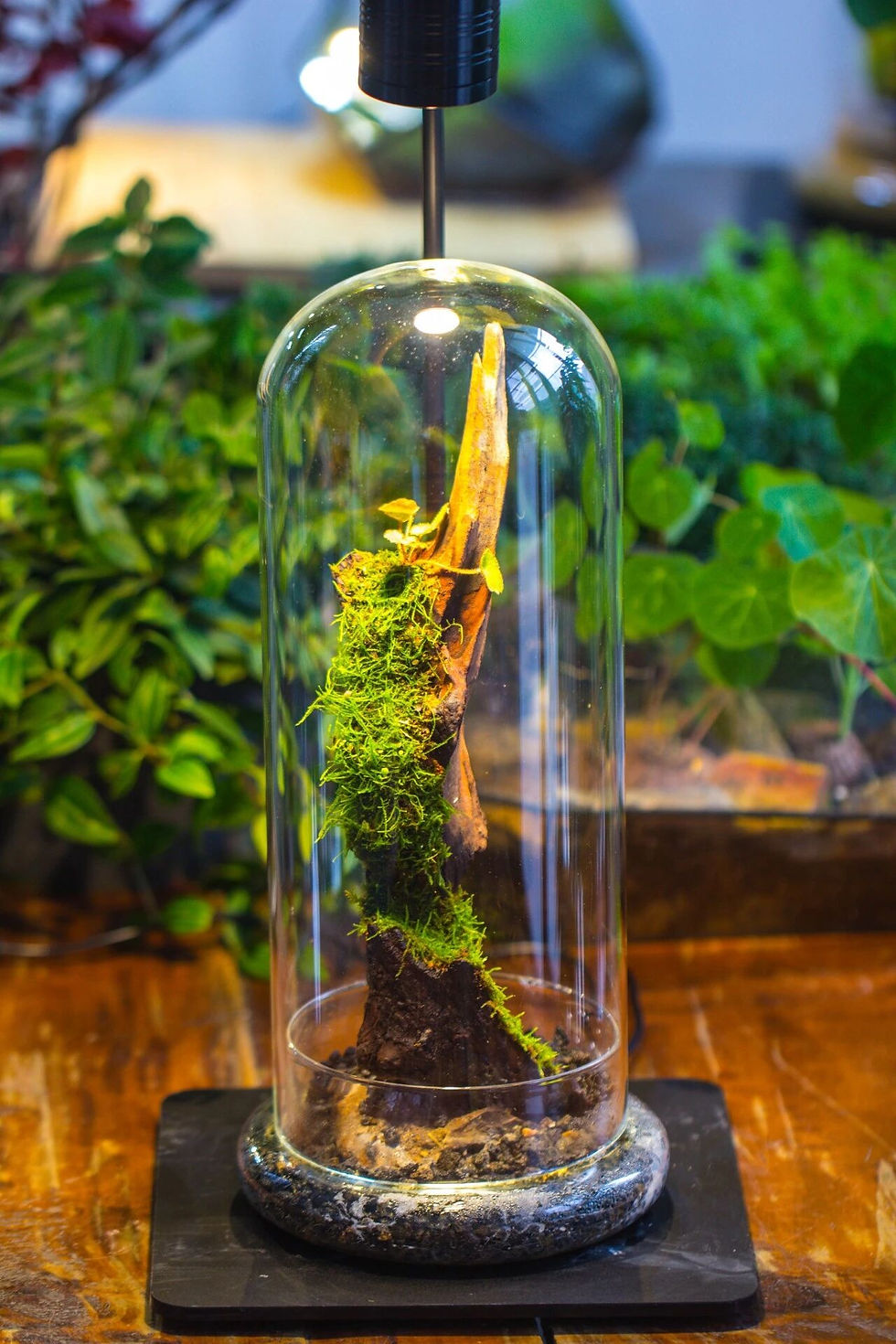
That is why I strongly recommend keeping a close moss terrarium with a light indoors.
It makes a beautiful interior decoration, does not require a large flowerpot, and does not require you to buy large amounts of potting soil. Mosses and small plants are also highly ornamental, and caring for them is not as complicated as it may seem.


Comments