


vintage bioactive house terrarium projects house: moss, begonia, ferns, and Biophytum sensitivum

Updated: Sep 17
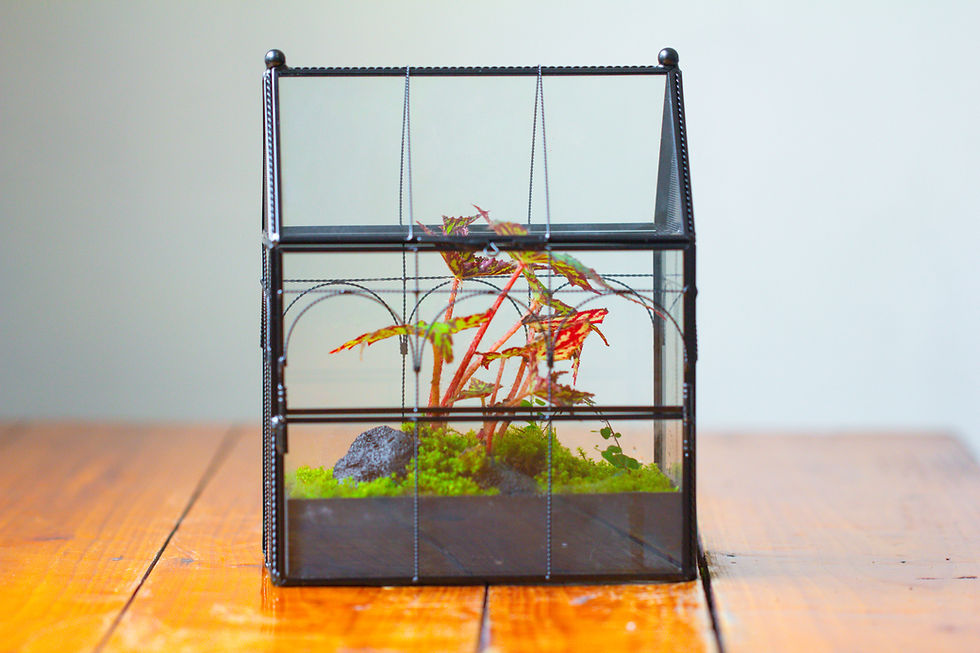
I have shared this small vintage house terrarium many times before. It is very suitable for keeping mantises and adult jumping spiders.
Before, my watering method for this terrarium was misting.
Misting is still the best method. It can provide water for the insects, and it also helps moss and other plants grow.
However, some people have told me that they had problems with water leaking.
So now I have added this inner planting tray. With this tray, you no longer need to worry about leaking water.
This is the first bioaactive terrarium project:
Plants used in this setup: Begonia, creeping figs, and star moss.
The creeping figs is optional. I only used it because there was a small piece growing in the plant pot.
Rocks: small lava rock pieces, plus two slightly larger lava rocks.
Soil: the original soil from the Begonia pot.
Planting tutorial:
Add a layer of small lava rock pieces.
Plant the Begonia using the soil that already comes with it.
Because this tray is quite shallow, the Begonia may lean to one side. You can use a larger lava rock to support it and keep it in place.
Add the moss on top.
And that is it.
One important point:
Because this setup is made for baby mantises, or other small insects you may want to keep, I chose a Begonia with large leaves on purpose.
Small insects can stay under the leaves or rest on top of the leaves.
They can also climb all the way to the top of the little house terrarium.
building video:
The second vintage house terrarium projects: with Biophytum sensitivum, Wild Maidenhair Fern, and Moss

There are three plants in this setup:
Biophytum sensitivum
Wild maidenhair fern
Star moss
First, let’s talk about Biophytum sensitivum.
Biophytum sensitivum also belongs to the Oxalidaceae family. It is very easy to grow.
It is basically a small tropical and subtropical herb from Asia. It likes a warm environment, humid air, moist soil that does not stay compacted for too long, and bright light without strong direct sun.
In a bright indoor place, it is very easy to keep alive. This is already my fourth one. In a bright indoor environment, it grows very well.
Next is the maidenhair fern.
This is a wild maidenhair fern. I found it growing on a damp wall and lifted it off with a small shovel.
It did not come with much soil. Its root system is also very small and shallow.
Only wild maidenhair ferns have this kind of open, sparse leaf shape when they are still this small.
In the warm south, in raining season, when maidenhair ferns grow very well, if you go out for a walk, pay more attention to stone walls along the road. You may be able to find this type of fern.
Find the root area and carefully lift it off. Even if it only has two or three leaves, or if some leaves break during the process, it is fine.
After you bring it home, keep it in a humid enclosed environment. It will soon grow new leaves.
If you are worried that the weather is too hot, use a container with ventilation holes.
The moss I used here is star moss that I bought online.
Planting tutorial:
Add a layer of small lava rock pieces.
Plant the Biophytum sensitivum using the soil that already comes with it.
Add the moss on top.
Use tweezers to tuck the maidenhair fern between the moss.
For care, just mist it with water.
This is what it looks like right after planting.
The leaves of the Biophytum sensitivum are still hanging down because the sun was quite strong when I planted it. The air became dry very quickly.
After planting and watering it, it looked much better.
For watering, I still use misting. At most, I just mist more than a close terrarium, for this one is well vented .
The soil for ferns and moss should stay moist.
In this kind of setup, it is actually easier to observe the moss. If the moss becomes dry, shrunken, and wilted, then it definitely needs water.
P.S.
Recently, some people shows me photos of their ferns, saying that their ferns are not doing well. The leaves dry out, wilt, or become crispy.
This is usually caused by not watering enough.
Ferns love water very much.
For some other plants, if they lack water for half a day or one day, the leaves may only wilt. After watering, they can recover.
But ferns, especially maidenhair ferns, are not like that.
If they dry out for even half a day, the leaves may not recover.
In that case, you can only cut off the old dry leaves, water the plant well, and wait. New leaves will grow again very soon.
This is also part of how they adapt to their environment.
Think about it. In tropical areas, the sun can be very strong. Dry air can quickly burn the delicate leaves of maidenhair ferns.
When the leaves dry out, the plant is actually stopping the damage in time.
When the rain comes again, it quickly grows new leaves and continues growing.
So for ferns, the soil should always be kept moist. Water them every day.
It is better to water more than too little.


Comments